Bed Design History · Materials & Craft
Reading the Craft of Vispring: Wool, Cotton, and the History of Mattress Ticking
A mattress is often hidden beneath sheets, blankets and a beautifully considered bedstead. Yet its quiet outer layer—the ticking—has long done more than cover the interior. It protects the materials within, shapes the character of the finished bed and tells a story about changing ideas of comfort, care and craftsmanship.
Published November 6, 2026
Look closely at a traditional mattress and the details begin to read like a small history of domestic life. A firm woven cover contains springs and upholstery; rows of stitching hold layers in place; tufts draw the surface into a carefully controlled form. Beneath the visible fabric, fibers such as wool, cotton, horsehair and coir each contribute a different quality. Together they reveal a long-standing principle of bed design: comfort is not created by one material alone, but by the considered relationship between structure, filling and cover.
Vispring’s use of natural materials offers a contemporary way into that history. Its mattresses make visible a vocabulary associated with traditional upholstery: hand-nested pocket springs, natural fillings, hand tufting and a substantial woven ticking. The interest is not simply in nostalgia. It lies in understanding how these techniques work, why they endured and how historical construction continues to inform present-day expectations of a bed.
The quiet work of mattress ticking
In mattress making, ticking is the durable outer fabric that encloses the mattress’s inner components. The word is often associated with tightly woven striped cotton covers, but ticking is better understood by its purpose than by a single appearance. It must withstand friction and pressure, keep fillings contained, support the mattress’s construction and provide a finished surface suitable for regular use.
That practical role distinguishes ticking from bed linen. Sheets are removable textiles intended to sit between the sleeper and the mattress, while ticking is part of the mattress itself. A sheet may be laundered and changed; ticking is built into the object and is not ordinarily treated as a washable layer. It is a working skin: protective, structural and, in many beds, an important part of the visual finish.
Historically, mattress covers were closely tied to the materials and methods available to local makers. A cover needed a close enough weave to retain its filling, but also had to be robust at seams and edges. As mattress interiors changed—from loose natural fillings to more complex upholstery and spring systems—the demands on the outer fabric changed with them. Ticking became part of a larger engineering problem: how to create a bed that held its shape, felt inviting and could withstand nightly use.
From stuffed mattress to upholstered system
For centuries, beds were made in many forms, and the word “mattress” described a broad range of stuffed sleeping surfaces rather than one standardized construction. Materials could include straw, wool, feathers, hair or other locally available fibers. They were contained within fabric cases and placed on a bedstead, often alongside additional layers intended to improve softness or warmth. Construction varied substantially by period, region, household means and access to skilled labor.
The important historical shift was not a single invention or a clean break from older methods. Instead, mattress making gradually became more specialized. As workshops refined upholstery, makers combined fillings with stitched covers, internal supports and edge treatments. The result was a more deliberately constructed sleeping surface, in which each layer had a distinct task. Ticking was essential to that system: without a resilient enclosure, carefully arranged upholstery could migrate, escape or lose its intended form.
Industrial production and the spread of metal spring technology brought further changes. Spring interiors could offer more responsive support than a simple mass of stuffing, but they required upholstery above and around them. Natural fibers remained useful as cushioning, insulation and a means of softening the spring structure. The mattress evolved into a layered object, and the outer fabric had to accommodate the movement and pressure of everything beneath it.
Cotton: a versatile cover for the bed
Cotton became a familiar choice for mattress ticking because it can be woven into sturdy fabrics and tailored into practical covers. Its qualities depend on the yarn, weave, weight and finishing; “cotton” alone does not describe how a particular textile will perform. A tightly constructed fabric may help contain upholstery, while a well-made seam and suitable thread contribute to the enclosure’s durability.
In the history of bedding, cotton also belongs to a broader domestic textile landscape. It appears in sheets, pillowcases and covers, but those uses should not be confused with mattress ticking. Cotton sheets provide a launderable layer of comfort and hygiene. Ticking, by contrast, protects the mattress interior and forms part of its construction. A bed may bring both together, with a cotton cover enclosing the mattress and cotton bed linen completing the sleep surface.
The contrast between weave types is especially relevant to everyday comfort. Percale is generally associated with a crisp, matte hand; sateen tends to feel smoother and show a gentle sheen. These terms describe fabric construction, not a guarantee of quality, and neither is automatically superior. In a mattress cover, durability, seam strength and suitability for the upholstery system matter at least as much as surface character. In sheets, feel and care preferences may take greater precedence.
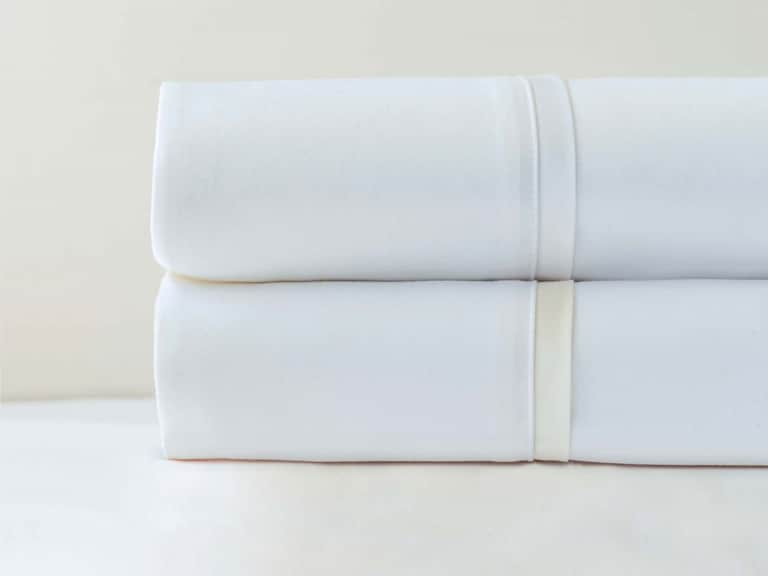
That distinction can be seen in the BOVI Estate Sheet Set, made from long-staple cotton sateen. It is an example of cotton used as bed linen: a smooth, removable layer that sits above the mattress. It offers a useful point of comparison, not a substitute for ticking. Considering these different roles helps clarify how fabric choices operate across a whole bed, from the durable enclosure underneath to the tactile textiles closest to the sleeper.
Wool: warmth, resilience and a living fiber
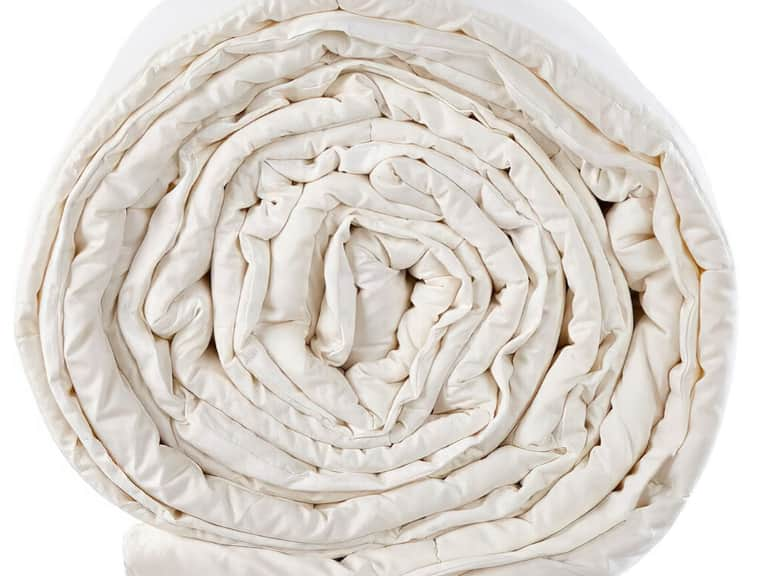
Wool has a particularly long association with bedding because it can contribute warmth without being reduced to a simple measure of heaviness. Its crimped fibers can trap air, and wool can absorb moisture vapor while retaining a comparatively dry feel. These characteristics help explain why it has served as upholstery, padding and comforter filling across different contexts. The specific result depends on the wool, its preparation, the quantity used and the way it is assembled within the bed.
In mattress construction, wool may appear as part of an upholstery blend or as a layer over a spring system. It can soften the transition between the support structure and the cover, while contributing body and a degree of resilience. Cotton is sometimes blended with wool in batting, combining fibers with differing qualities. Such blends are not merely decorative references to traditional materials; they are choices about how a mattress is built and how its layers work together.
Natural fibers should not be treated as interchangeable or automatically ideal for every sleeper. Wool, cotton, horsehair and coir each behave differently, and the finished experience depends on their arrangement. Nor does a natural filling alone determine durability, comfort or ease of care. Construction, density, workmanship, mattress support and maintenance all have a part to play. The useful question is not whether one fiber is universally best, but what function it performs in a particular design.
The craft of layered construction
Traditional mattress upholstery is a composition of materials and techniques. Springs provide a supporting structure; padding layers modify the feel above them; a border encloses the sides; and ticking finishes the exterior. Hand tufting can help secure layers and control how the upholstery sits. On some mattresses, tufts pass through the structure and are finished with washers, keeping internal components more stable under repeated pressure.
These methods are easy to mistake for ornament. Tufting does add a distinct, tailored appearance, but it also has a practical history within mattress construction. By drawing layers together at intervals, it can reduce excessive movement and help maintain a controlled profile. Hand side-stitching along the border is another mark of upholstery labor, reinforcing the edge and contributing to the mattress’s shape. Neither technique should be read in isolation: its value depends on the materials, design and quality of execution around it.
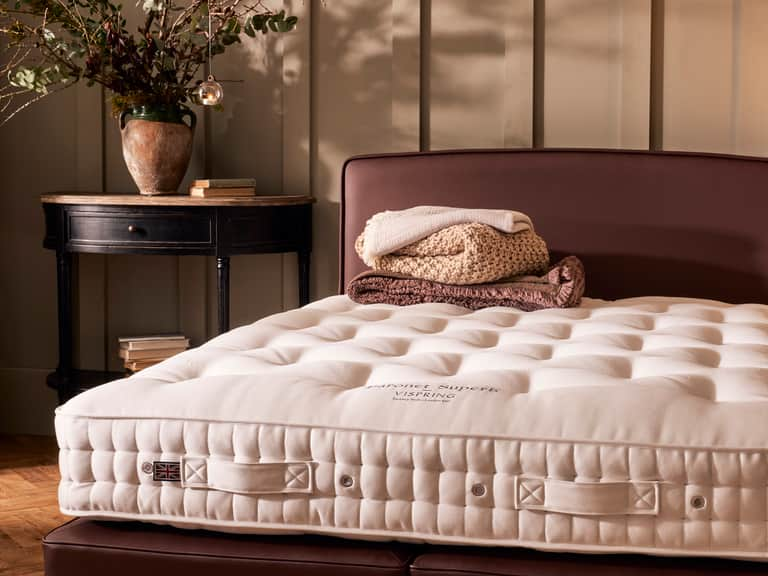
Vispring’s Baronet Superb Mattress illustrates how these elements can be brought together in a contemporary mattress with a traditional materials vocabulary. Its listed construction includes hand-nested calico pocket springs, natural upholstery fillings such as British fleece wool and cotton, horsehair and hand tufting. The product description also specifies wool and viscose ticking. It is a useful case study in how a current bed can draw on established upholstery language while being designed for modern use.
That example is not a template for every historical mattress. Mattress design varies widely, and brand-specific construction should not be mistaken for a universal account of the past. Rather, it provides a tangible way to consider how spring systems, natural fillings and ticking relate within a finished object. The bed’s appearance may be restrained, but beneath the cover sits a series of choices about support, containment, resilience and craft.
Calico pockets, springs and the language of support
When a mattress description refers to calico pocket springs, it is naming two parts of a system. The springs are enclosed individually in fabric pockets, allowing them to respond with some independence from one another. Calico is a plain-woven cotton fabric often associated with this kind of spring enclosure. It is not the same as the outer ticking, although both fabrics contribute to the mattress’s overall construction.
Hand-nesting describes the arrangement of pocket springs by a maker, rather than simply the presence of a spring unit. The relationship between spring count, wire, tension, mattress size and upholstery influences the result; a higher number of springs does not, by itself, establish that a mattress will suit every person. Support is experienced in combination with body, sleeping position, the bed base and the sleeper’s own preferences.
This is one reason to read mattress terminology with care. A label such as “natural” speaks to material content, while terms such as “hand-tufted” or “pocket spring” describe aspects of construction. Neither tells the whole story on its own. To understand a mattress, ask what each layer does, how it is secured, what the cover is made from and how the complete system is intended to be used.
A history written in surfaces
Mattress ticking has a visual history as well as a technical one. Stripes and other woven patterns became recognizable features of bedding, while later covers could be quieter, more tailored or coordinated with a broader bedroom aesthetic. Even when a mattress is concealed beneath linens, its construction belongs to the visual culture of the bedroom: the crisp edge beneath a coverlet, the height of the sleeping surface and the way the bed meets its frame all shape the room’s proportions.
In a retro or historically informed interior, the appeal of an older bed often lies in the harmony of its parts. A streamlined frame may call for a mattress profile that preserves its silhouette; a more substantial upholstered bed can accommodate a layered, generous surface. The frame and mattress should be considered together, including dimensions, support requirements and how bedding will drape. Historical reference is most persuasive when it attends to those relationships rather than relying on a few nostalgic motifs.
There is also a quiet pleasure in understanding what is usually hidden. The care in a seam, the choice of a breathable fiber, or the way a tuft holds upholstery in place can turn an ordinary household object into a record of skilled making. The materials are not a costume applied to the bed; they are the means by which its form and function are achieved.
Caring for a mattress and its textiles
Ticking is not designed to be washed like a sheet. Routine care generally means protecting the mattress with clean bed linen, following the manufacturer’s guidance and addressing spills promptly without saturating the interior. Excess moisture can be difficult to remove from layered upholstery and may affect fillings or construction. A removable mattress protector can provide an additional barrier, but it should be selected to fit the mattress properly and should not be confused with the mattress’s own ticking.
For natural upholstery, care instructions deserve particular attention. Wool and other fibers can respond differently to moisture, heat and agitation. Avoid assuming that a mattress can be aired, vacuumed or treated in the same way as a duvet or sheet; the correct method depends on its construction and manufacturer’s recommendations. Regularly changing and laundering sheets, maintaining a suitable bed base and using a protector where appropriate are practical habits that help preserve the sleep environment without subjecting the mattress to unnecessary cleaning.
When restoring or assessing a vintage mattress, caution is especially important. Age, storage conditions and unknown materials can complicate cleaning or repair. A mattress may look sound while its internal upholstery or springs have deteriorated. For an historically significant bed, a qualified conservator or experienced upholstery specialist can help distinguish preservation from renovation. Replacing fabric or fillings may improve usability, but it can also remove evidence of original construction; the right approach depends on the object’s condition and significance.
How to read a mattress description
For anyone exploring bed design history—or simply trying to understand a contemporary mattress—a short checklist can make material language more meaningful:
- Identify the layers. Separate the spring or support core from upholstery fillings and the outer ticking.
- Ask what each fiber contributes. Wool, cotton, horsehair and coir have different properties and may be used in different positions.
- Distinguish ticking from bed linen. The former is an integral mattress cover; sheets are removable textiles placed over it.
- Look for construction details. Tufting, side-stitching and pocketed springs describe methods, not merely a style.
- Consider the full bed. Mattress dimensions and profile should suit the bedstead, base and bedding.
- Follow care guidance. Natural materials still require appropriate maintenance, and cleaning methods vary by construction.
Heritage without nostalgia
The strongest connection between traditional mattress making and contemporary design is not a longing for an imagined past. It is an appreciation of thoughtful construction. Wool and cotton have remained part of the bedding conversation because they can serve useful functions, not simply because they look appealing in a period setting. Ticking has endured because the mattress needs a dependable enclosure. Hand finishing continues to attract attention because it can express both workmanship and purpose.
Reading the craft of Vispring through these details offers a broader lesson in bed design: comfort is a collaboration between materials, structure and care. A spring system cannot be separated from its upholstery; ticking is more than an attractive cover; and natural fibers are most interesting when understood in context. For the design-minded reader, the mattress becomes less of a hidden commodity and more of a carefully assembled object—one whose quiet construction has shaped the way bedrooms feel, function and endure.